Upcoming
June 18, 2024
CEST
Polish
Recording: Managing Product Data Across Multiple Markets

Managing Product Data
Across Multiple Markets
Watch an in-depth session on how structured product information and PIM technology can drive e-commerce growth across multiple markets — available to watch anytime, no sign-up date required.
Everything you need to know
| Topic Why growing across markets takes more than a translated catalog — it takes organized product data | Who it's for E-commerce managers, digital leaders, and product data teams scaling across channels |
| Format On-demand webinar | Speakers Mariusz Labudda (Sportano.pl) & Kamil Niedziewicz (Ergonode) |
| Language English | Availability Watch instantly, whenever it suits you |
Ready to jump straight in?
Mistakes get expensive when you enter a market unprepared
Let's start with the core insight of this session: expansion rarely fails because of marketing. It fails because of chaos in the underlying product data — data that only reveals its cracks once sales are already live in a new market.
A native speaker won't rescue weak data — but weak data will quickly undo the value of good localization.
Localization only works once your product data is organized and built on a clear structure.
Curious how organized your own catalog really is?
The main PIM challenges of operating across multiple markets
Managing hundreds of categories
Complex, market-specific classification that has to stay consistent as the catalog grows.
Managing thousands of variants
Multi-level structures of options — color, size, material — that multiply fast across regions.
Managing materials and content
Large libraries of assets and attributes, each carrying its own set of parameters to track.
Hear how Sportano.pl works through these exact challenges — watch the full session.
What a PIM platform actually does
A PIM platform streamlines how you create, collect, enrich, and distribute product catalogs — centralizing and unifying every piece of product information across the organization.
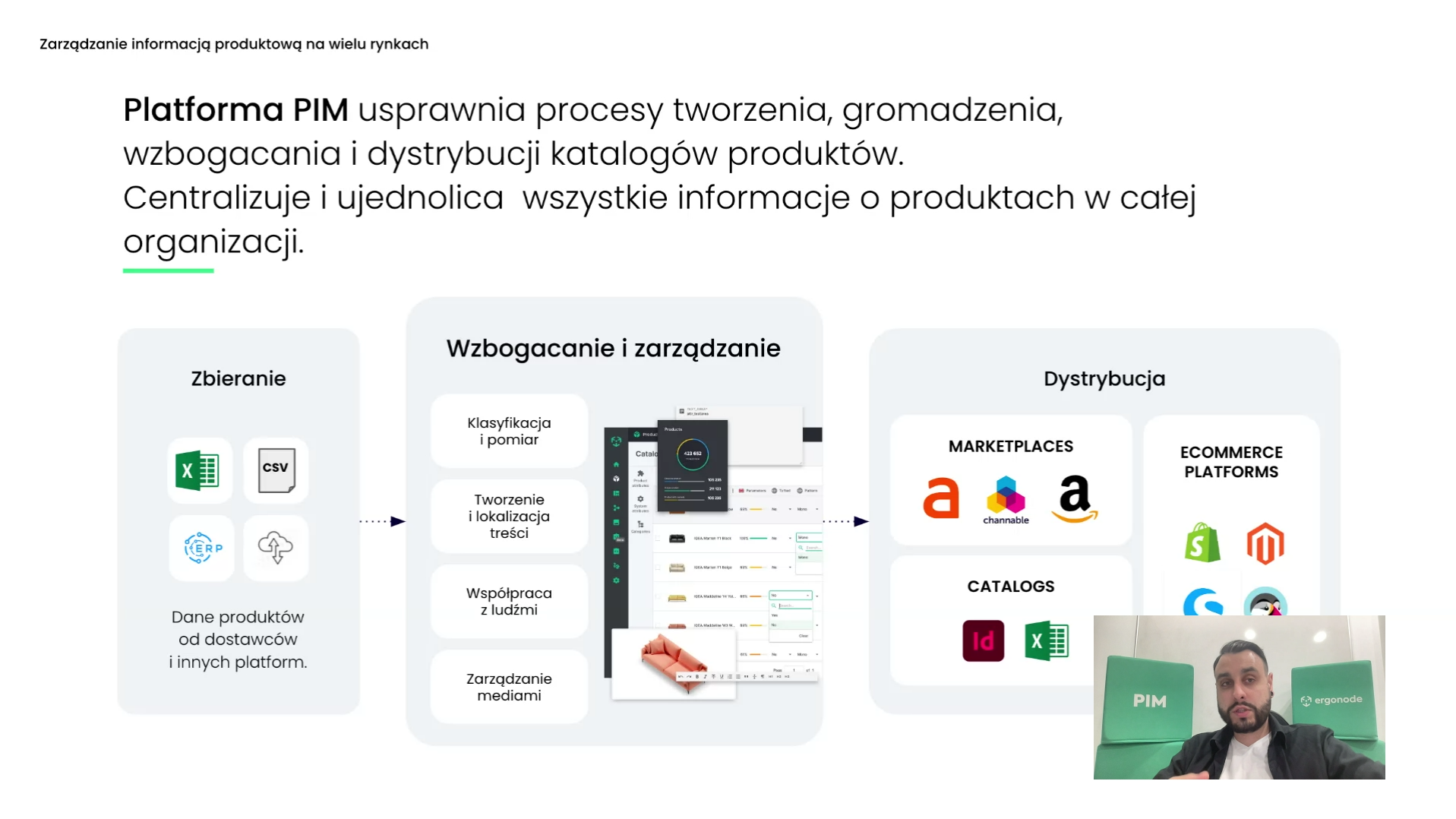
Straight from the session — the full collect → enrich → distribute flow.
1Collect
- Product data from suppliers
- Feeds from Excel & CSV files
- ERP system connections
- Data from other platforms
2Enrich & manage
- Classification and measurement
- Content creation and localization
- Collaboration with your team
- Media management
3Distribute
- Marketplaces (Amazon and others)
- E-commerce platforms (Shopify, Magento…)
- Print and export catalogs
Want to see this workflow set up around your own product data?
Why product presentation decides the sale
of online shoppers link purchase problems back to poor product presentation
say an accurate product description is the top factor in deciding to buy
point to a good product photo as the deciding factor at checkout
See exactly how these numbers play out for a real catalog — watch the full session on demand.
Real experience from the front line of e-commerce

Mariusz Labudda
Over 10 years of experience in e-commerce and marketing, leading digital growth at Sportano.pl — one of the fastest-growing sports retailers in Central Europe. He shares the real challenges of managing product data at scale, the importance of consistent product attributes, and strategies for building seamless cross-border commerce experiences.

Kamil Niedziewicz
Guides the conversation through how PIM turns scattered spreadsheets and supplier feeds into a single, structured source of truth teams can actually scale on.
Have questions for Kamil or the Ergonode team before you dive in?
What you'll learn
Turn better product data into stronger e-commerce performance
Watch the full recording on demand, then see what a structured PIM setup could look like for your own catalog.
Watch the recording → Book a free demo
Other webinars