
Digital Product Passport in the Textile Sector: Comprehensive Guide


The Digital Product Passport is coming for fashion. Here's what's actually in it.
An 18-page, plain-English summary of the European Parliament's draft study on the Digital Product Passport (DPP) for the textile sector — what it will require, who it touches, and how the rollout unfolds between 2027 and 2033.
Based on the draft study document of the European Parliamentary Research Service, published by Jérémy Legardeur and Pantxika Ospital, March 14, 2024. · PDF format
Textile is facing three challenges at once
The study opens with the reason the EU is legislating at all: fashion's current model is running into a wall on three fronts.
A wasteful, polluting model
The industry is known for heavy use of non-renewable resources and intensive water and land use — a footprint that's getting harder to justify or hide.
"Business as usual" points down
Projections for the sector show decline ahead, driven by raw-material shortages and rising energy, water and labor costs.
Opaque, exploitative supply chains
Worker exploitation and non-compliance with human-rights standards keep surfacing — enabled by supply chains no one can fully see into.
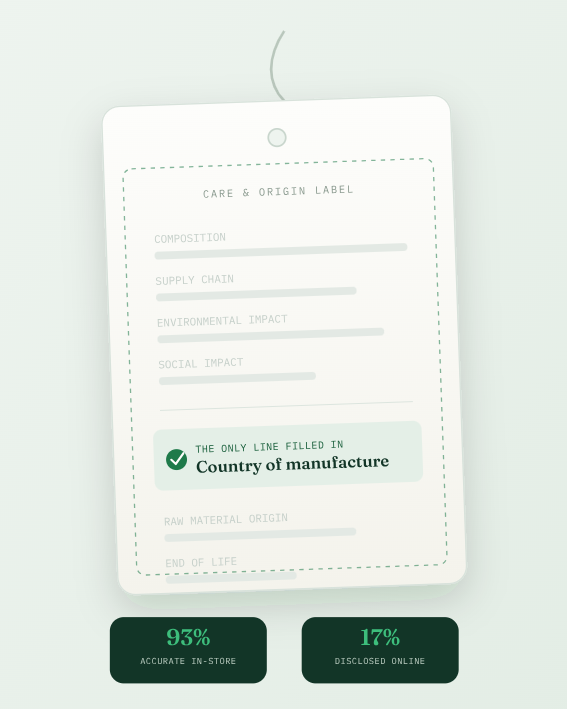
93% of brands stop at "country of manufacture"
93% of brands' most accurate in-store traceability information is simply the country of manufacture — and only 17% disclose even that much online. From the authors' 2021–2023 fieldwork on textile traceability (Ospital et al., 2023).
Six things this e-book actually walks you through
No fluff — this is a summary of a real EU policy study, organized so you can find the part that matters to your team.
Why textiles need a passport
The ecological, economic and social case the EU is legislating against — and why fashion specifically.
What a DPP actually is
The study's working definition: an identifier plus lifecycle data — and how the authors extend it beyond luxury goods.
The traceability gap
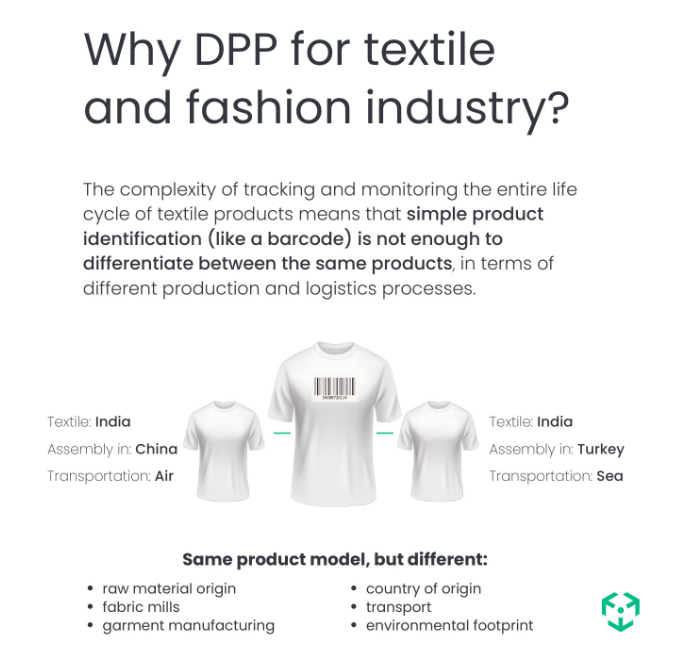
Why a barcode or a "country of manufacture" label can't distinguish two otherwise-identical garments.
11 objectives, 8 stakeholders, 16 data fields
The full anatomy of what a textile DPP is meant to carry, and who it's meant to serve.
A lifecycle model for textile
A proposed data model spanning raw material, production, distribution, use and end of life.
The rollout roadmap
Three phases, from a minimal DPP in 2027 to a full circular DPP by 2033 — with what's due at each step.
What it's for, who touches it, what it carries
The study breaks the DPP down into three lists. Together they define, very concretely, what a textile Digital Product Passport is.
11 objectives a DPP can serve
From helping a shopper choose, to helping a brand fight counterfeits.
8 stakeholder groups
Everyone the study identifies as having a reason to read or write DPP data.
16 categories of information
What the study proposes to actually attach to a product record.
One data model, shared across the whole lifecycle
The authors' DPP model proposes a shared set of data categories that follow the product around the loop — from raw material to fiber, garment, brand, distribution, use and, eventually, recycling or disposal.
.jpeg)
Three phases, three dates, three tags on the rail
The e-book lays the rollout out as three concrete phases. Here's what's due at each one.
Minimal & simplified DPP
- Recycled content, hazardous substances, plastic microfibers
- Recyclability of the finished product
- Location of key production steps: confection, weaving, knitting, dyeing, printing, wet processes
- Packaging: recycled content, recyclability, re-use potential
- Environmental impact and product innocuity
Advanced DPP
- Interoperability across PIM, ERP, second-hand platforms and certification/audit systems
- Automated data collection through APIs and common protocols
- Standardized tracking (QR code, barcode) from raw material to recycler
- DPP applied consistently sector-wide, including imports
Full circular DPP
- Scaling using lessons from earlier phases: surveys, workshops, FAQs
- Reaching the full value chain, including foreign suppliers
- Using the accumulated data — with AI — to shape circularity policy
Your product data, already structured for a DPP
- Centralise composition, supply chain, and compliance data on every product card
- Keep traceability data current across every SKU as the phase 1, 2, and 3 requirements tighten
- Export it in whatever format the DPP ends up taking — QR code, NFC, or a structured feed
.jpeg)
e-book


