PIM Data Types Explained: What Every Team Should Know

PIM Data Types Explained: What Every Team Should Know
Managing product information efficiently is essential in modern commerce, and understanding the different types of data that can live in a product information management (PIM) platform is equally critical.
Whether you’re in marketing, operations, data, or IT, clarity around PIM data types empowers your team to collaborate, scale, and deliver consistency across channels.
In this article, we’ll walk through what PIM data types are, the specific categories your business should manage (from product attributes and SKUs to compliance data and localisation), and how you can optimise your workflows using a platform like Ergonode.
What PIM Data Types Are
In its simplest form, “PIM data types” refer to the various categories or formats of information that a PIM system holds, organises, and distributes.
A PIM functions as the central hub for product information across your business. According to a definition by Adobe, a PIM system lets you “store, enrich, and distribute complex product information” to multiple channels.
Understanding which types of data belong in the PIM is key to avoiding data silos, ensuring accuracy, and delivering seamless experiences across channels.
In practice, PIM data types can be grouped into structured vs. unstructured, or core vs. enriched. Structured data might include SKUs, UPCs, prices; unstructured could include user‑generated content, images, videos.
Proper classification helps teams decide what lives in PIM versus what is managed elsewhere (e.g., through ERP, CRM).
Core Product Data
At the heart of any PIM system lies core product data. These are the essential details that define your products and make them discoverable, sellable and manageable.
Product Attributes
Product attributes are descriptive features such as colour, size, material, finish, gender or style. They form the backbone of filtering, searching and variation management. For example: “colour = Black”, “material = Cotton”, “size = XL”.
SKU Data
Stock Keeping Units (SKUs) serve as unique internal identifiers for each product variant. They are critical for inventory, channel‑sync, analytics and taxonomy. Many PIM tools stress SKUs and UPC/GTIN data as foundational.
Product Descriptions
These are the narrative, marketing‑and‑sales copy used to present the product to users: product titles, short descriptions, rich features, benefits, etc. This content often influences both conversion and SEO.
Product Specifications
Specifications cover technical details such as dimensions, weight, packaging details, material composition, performance ratings, care instructions, assembly instructions. Including accurate specification data reduces returns and increases trust.
Pricing Information
Pricing data includes list price, cost, discount price, channel‑specific price, promo price, and potentially tiered pricing. While some businesses prefer to keep dynamic pricing in ERP, PIM can store static or semi‑static price data for syndication.
Inventory Data
Inventory or stock‑level data indicates availability, warehouse location, reorder threshold, etc. Note: Some experts recommend limiting the PIM’s role in highly dynamic inventory data because of latency concerns and source‑of‑truth responsibilities.
Digital Assets
Today’s customers expect rich, visual, and multimedia content. A PIM platform must therefore support asset management alongside product data.
Images and Videos
These include hero shots, lifestyle images, 360° views, product-in‑use videos, unboxing videos, and user‑generated content. High‑quality visuals improve engagement and conversion rates.
Technical Data Sheets
These are downloadable documents (e.g., PDFs) that provide detailed specs, certifications, compliance details, and manuals. They’re especially important for B2B, industrial, or regulated products.
Marketing and Sales Media
This covers graphics, infographics, banners, animations and other media that support product presentation and storytelling. The PIM should link these assets to relevant SKUs and variants.
Product Categorization and Metadata
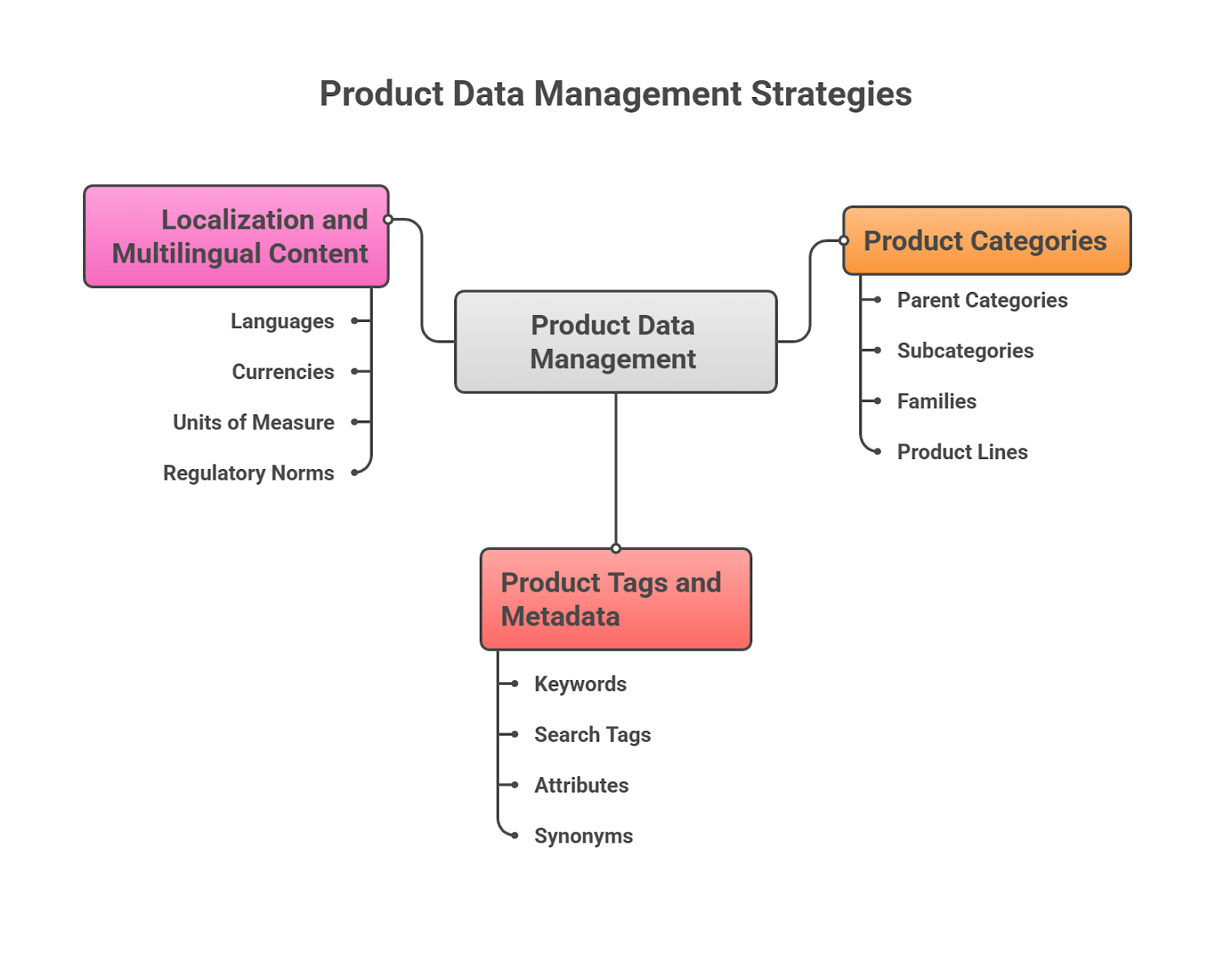
Organising product data effectively is essential for discoverability, navigation, filtering and consistent UX across channels.
Product Categories
This concerns the taxonomy of your product catalog: parent categories, subcategories, families, product‑lines. Correct categorisation helps navigation, channel mapping, and filtering.
Product Tags and Metadata
These are keywords, search‑tags, attributes, synonyms, alternate names, and custom fields. Metadata supports SEO, merchandising and internal search optimization.
Localization and Multilingual Content
Operating globally means your product data must adapt to different languages, currencies, units of measure and regulatory norms. Many PIM solutions support multi‑lingual content, localized descriptions and region‑specific attributes.
Supplier and Regulatory Data
Beyond basic product and marketing information, many teams must manage supplier, compliance and lifecycle‑related data.
Supplier Information
Details about vendors, manufacturers, sourcing location, contact details, certifications, and supply chain metadata. Having supplier data in PIM supports transparency and enables efficient data enrichment.
Compliance Data
Includes safety certifications, regulatory identifiers, hazard labels, warranty details, technical data required for legal compliance in different markets. This data is increasingly required for digital shelf readiness.
Warranty Details and Usage Instructions
Usage instructions, care instructions, assembly guides and warranty policies fall into this category. Well‑structured usage data improves customer experience and reduces service calls.
Variant and Relationship Data
Products often have multiple variants and relationships that require structured modelling.
Variant Data
Variants represent the same core product differentiated by size, colour, style, storage capacity, packaging type. Capturing variant data means avoiding duplication and enabling efficient updates.
Product Relationships
These include bundles, accessories, cross‑sell, upsell items, spare parts, complementary products. Mapping relationships helps in merchandising and enhances the overall product experience.
Material Information
Material or component data specifies fabric, ingredient, metal types, composite components. This is especially important for compliance (e.g., REACH, RoHS) and customer‑facing clarity.
Logistic and Transactional Data
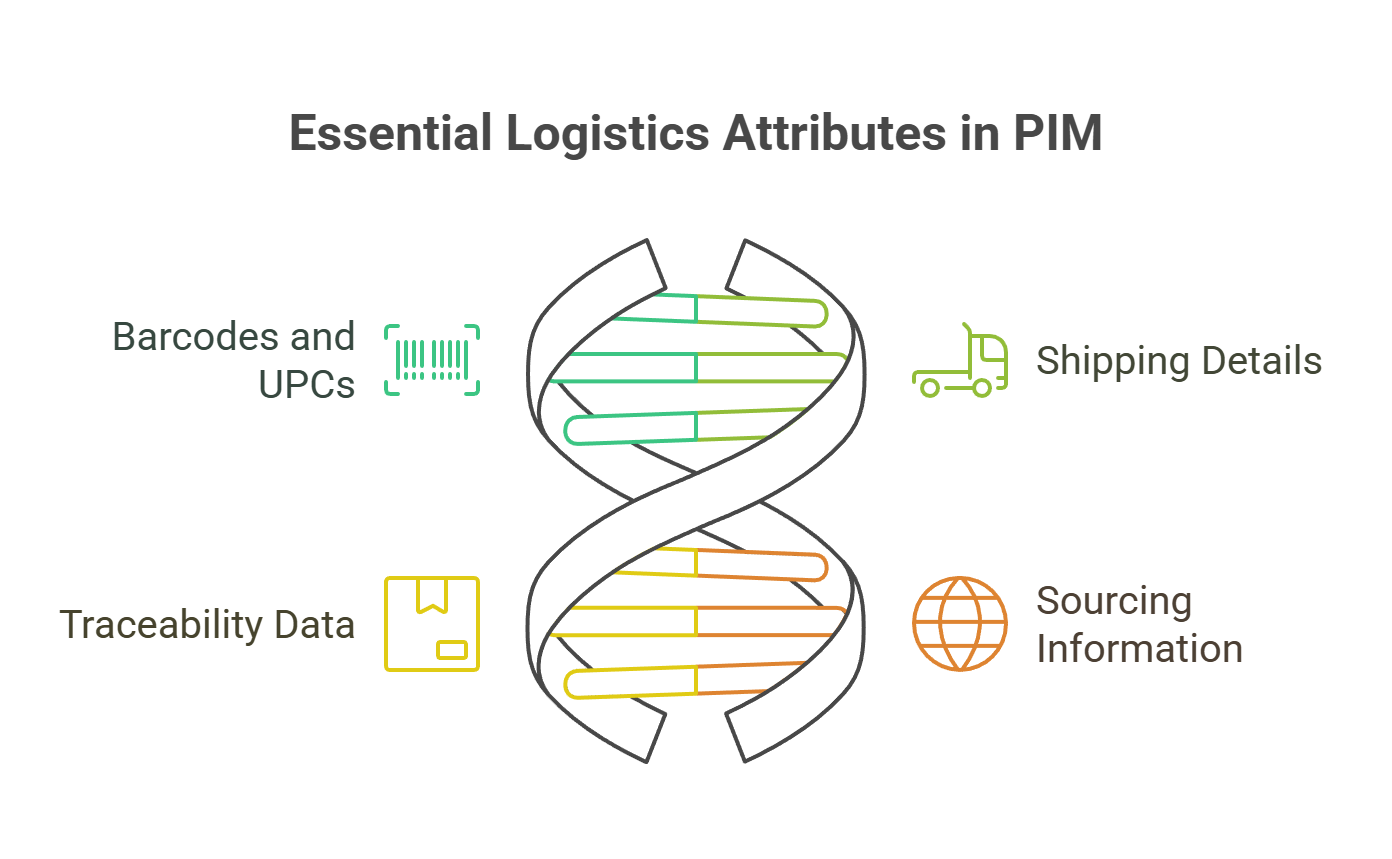
While some of this data may live primarily in ERP or logistics systems, certain logistics and transactional attributes belong in a comprehensive PIM setup.
Barcodes and UPCs
Standards such as GTIN, EAN, UPC, ASIN, manufacturer part numbers are essential identifiers for channel syndication and data mapping.
Shipping and Packaging Details
This covers dimensions, weight, shipping class, pallet count, packaging type, and logistics attributes. Including these in PIM supports downstream systems and ensures accurate product listings and shipping estimates.
Batch and Lot Numbers, Serial Numbers, Expiration Dates
Particularly relevant for regulated industries (food, pharma, chemicals), traceability data such as batch, lot, serial and expiration dates must be captured and potentially syndicated.
Sourcing Information
Linking logistical and sourcing metadata (country of origin, supplier chain, manufacturing location) supports compliance, sustainability, ethical sourcing and supply chain transparency.
Best Practices for Managing PIM Data
Successfully managing diverse data types requires proper governance, workflow, integration and structure.
Begin by establishing structured templates and data models. Define mandatory fields for each product family (e.g., SKUs required, weight required). Use consistent attribute naming and classification taxonomy to ensure data integrity.
Integrate your PIM platform with ERP, DAM (digital asset management), e‑commerce and marketplace channels. Centralising data in PIM reduces duplication, ensures one source of truth and simplifies syndication. According to Adobe, such integration helps marketing, sales and IT teams work efficiently.
Ensure data accuracy and regular updates. Stale or inconsistent product data undermines trust and can damage brand reputation. Leverage automation and bulk import/export capabilities to streamline enrichment and updates.
Consider channel‑specific requirements when managing data. Some marketplaces require specific fields, tagging rules or image formats. A flexible PIM accommodates this via channel templates and export rules.
Common Mistakes to Avoid
Even with a robust PIM system, missteps can hamper effectiveness.
One common error is storing highly dynamic data, such as real‑time inventory or pricing, in the PIM when those handles should reside in ERP or dedicated systems. As one expert noted, “inventory and pricing metrics should also come straight from the source” to avoid latency or mismatch.
Poor categorisation or lack of taxonomy planning also causes search and filtering issues: products become hard to find, variants are mis‑grouped, and channels struggle to map data correctly.
Ignoring localisation or compliance requirements is another pitfall. If your product data fails to reflect regional language, market regulations or currency, you risk inconsistency, mis‑sales or regulatory penalties.
Unlock the Full Potential of Your Product Data with a Modern PIM
Understanding the breadth of PIM data types, from core product attributes to compliance data, and from logistics metadata to digital assets, empowers every team within your organization.
When data is centralised, structured and enriched within a modern, API‑first PIM like Ergonode, you gain one source of truth, streamline workflows, enhance customer experiences and drive growth.